
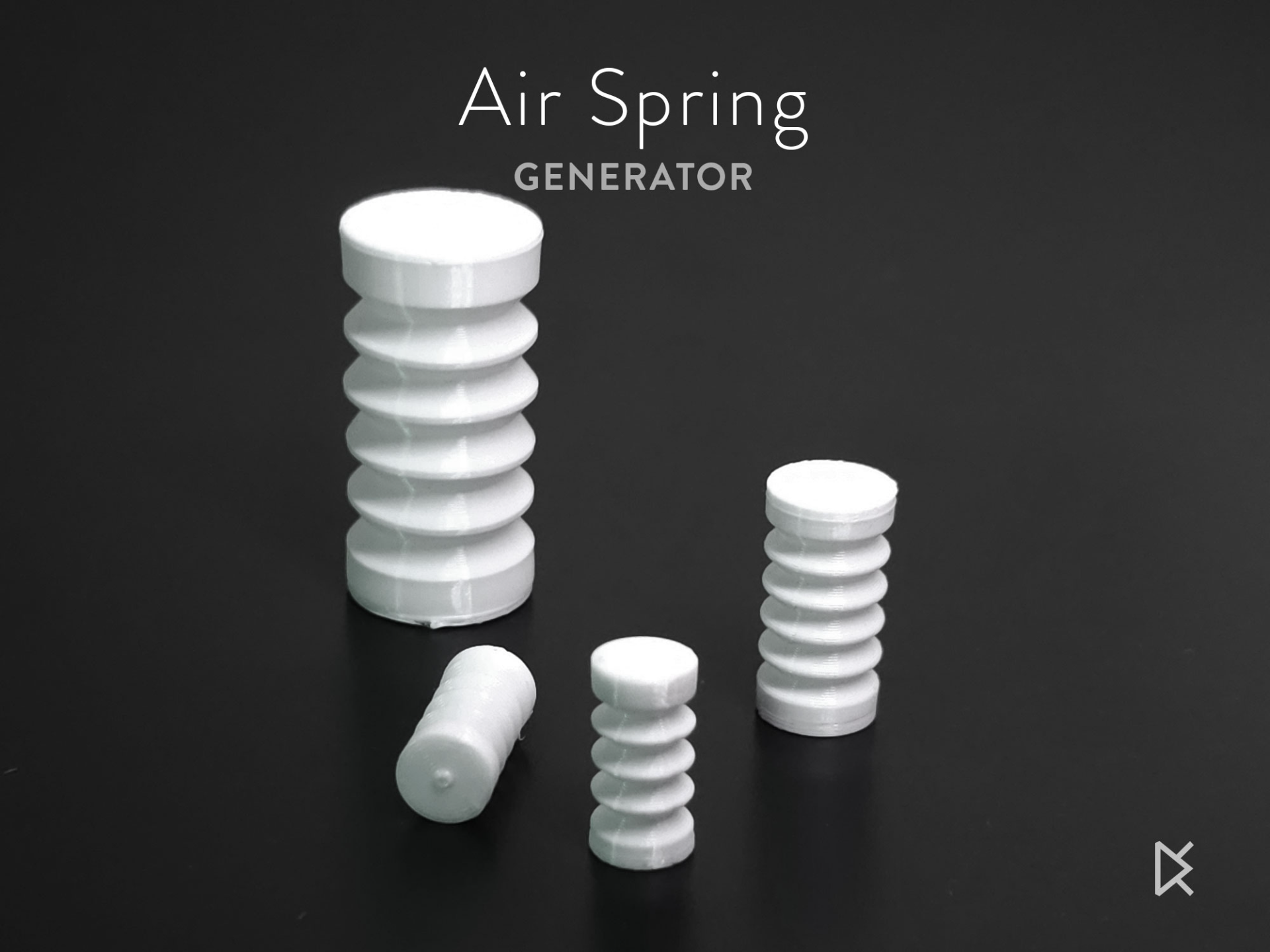
Air Spring is a parametric, 3D-printable elastic element: a fully hollow TPU cylinder with corrugated walls that works as a pneumatic spring. It is free to download on MakerWorld, and the OpenSCAD project lets you customise its height, diameters and number of coils.
What it is
Coil springs are difficult to 3D print and often brittle. An air spring takes a different route: it combines the natural flexibility of TPU with the compressibility of the air trapped in its internal volume. The design is based on hollow cylinders with corrugated side walls, which create an optimised zigzag profile that makes the TPU fold in a controlled way.
Advantages
- Sturdier than 3D-printed coil springs.
- Longer lasting, with no risk of warping.
- Parametric: sized to your needs.
Customizable parameters
Open the OpenSCAD project to customise:
- Height: the total dimensions of the spring.
- Diameters: the maximum and minimum wall expansion.
- Number of coils: controls the flexibility and compression range.
- End height: smooth mounting surfaces.
- Chamfer transitions: for optimal stress distribution.
Printing
| Profile | Time | Filament |
|---|---|---|
| Air Spring | 0.3 h | 1 g TPU |
The time and weight are those shown on MakerWorld and vary with printer and settings. The force of the spring depends on the air not escaping. Larger diameters may not support the upper bridge by themselves and can require some infill. This is version 1.0: improvements are welcome in the comments on MakerWorld.
Frequently asked questions
What is an air spring?
A hollow, corrugated cylinder in which the compressed air, together with the flexibility of the material, provides the springing force.
Why print it in TPU?
TPU is flexible enough to fold along the corrugated walls and return to its shape.
Can I change its size?
Yes. Open the OpenSCAD project and change the height, the diameters, the number of coils, the end height and the chamfers.
Where can I download the model?
For free on MakerWorld, using the Print button on this page.
When was it published?
On 1 August 2025.