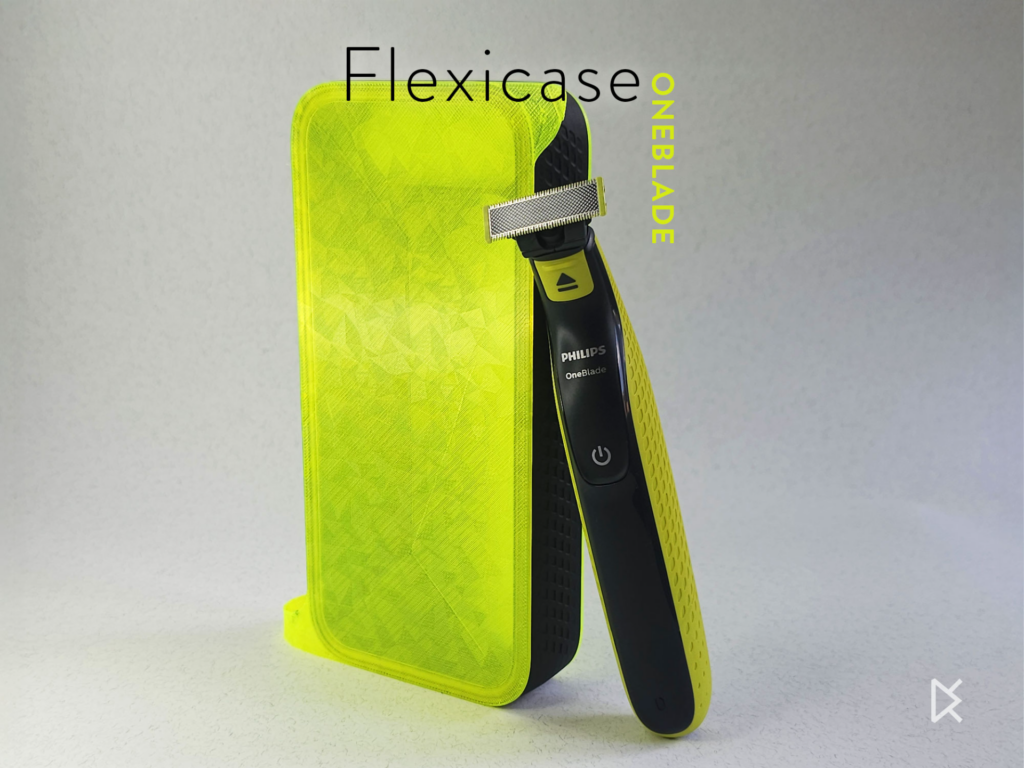
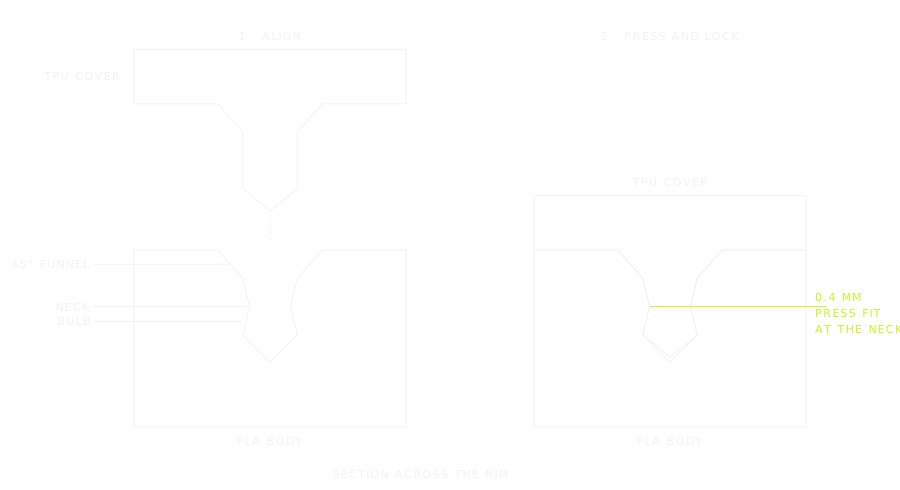
FlexiSnap is a snap-fit seal for 3D-printed cases. A rigid body in PLA has a groove around its rim; a flat cover in soft TPU has a matching rib. The rib is shaped like a rhombus: it squeezes through a narrow neck in the groove, then opens again behind it. The result is a closure that holds by itself, leaves no gap for dust or water to pass, and opens with a pull. It is the closing system of the Flexicase series and of the Flexi Case editor.
The problem
A printed box with a printed lid rarely closes well. A rigid lid needs tight tolerances, and a few tenths of a millimetre of warping leave a gap. Hinges and latches add parts. Rubber gaskets have to be bought and glued. FlexiSnap uses what a 3D printer already does well, flexible TPU, to make the lid itself the gasket.
How it works
- Funnel. The groove opens with a 45° chamfer that guides the rib in, so you do not need to aim: you press the cover down along the rim.
- Neck. Below the funnel the groove narrows. In the Flexicase geometry the neck is 0.4 mm narrower than the rib. The rib has to shrink to pass.
- Bulb. Under the neck the groove widens again to the full width of the rib. The rib springs back and is held: pulling it out means squeezing it through the neck a second time.
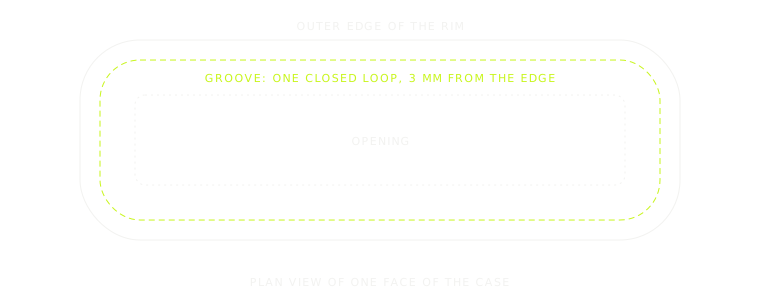
- Seal. The groove runs as a single closed loop around the opening, so the rib touches the wall all the way round. There is no corner where the seal stops.
Why TPU printed with walls only
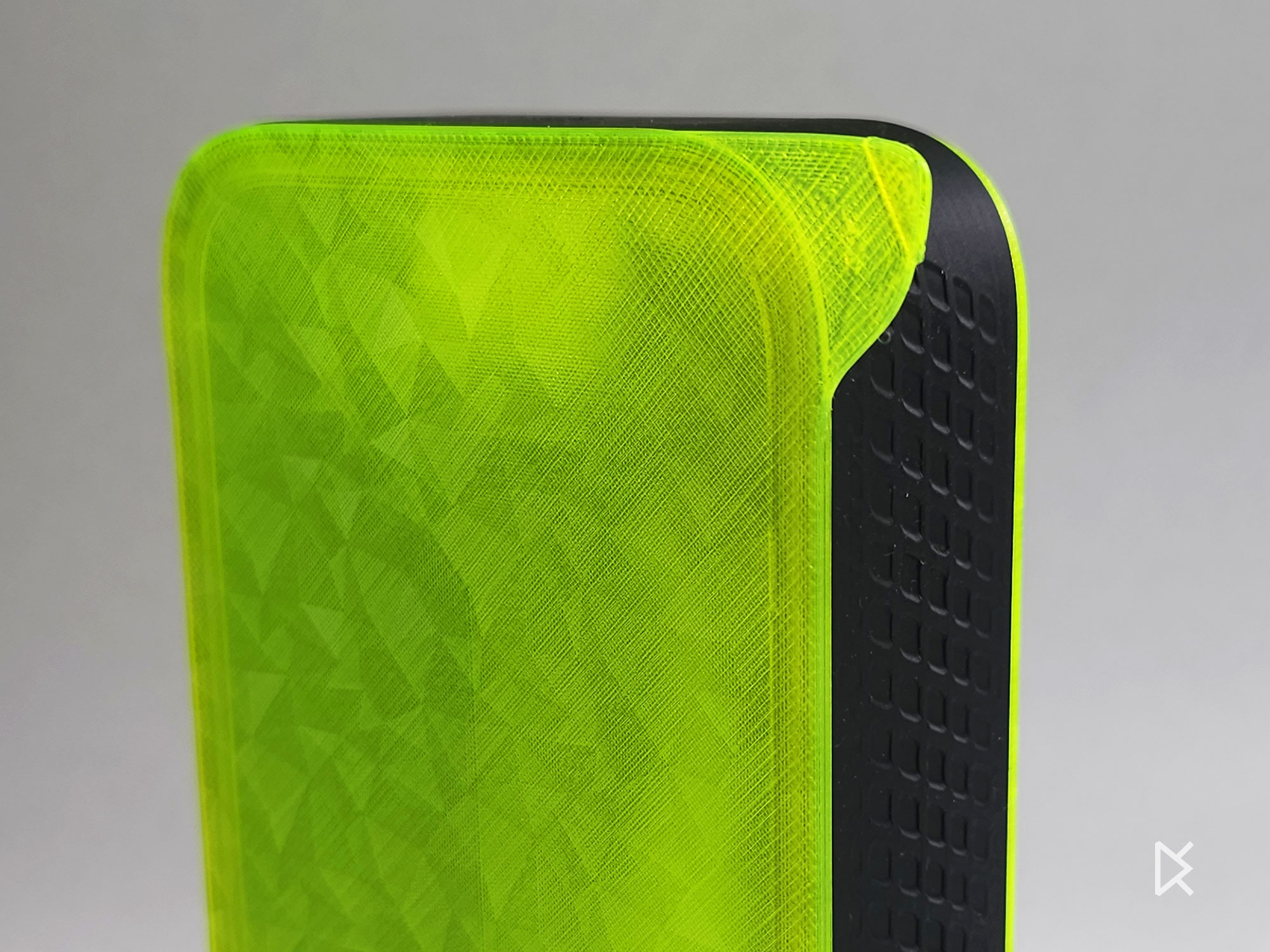
The rib is solid in the drawing, but it is printed with perimeters only and no infill. That makes it a thin-walled tube of soft TPU: stiff enough to hold its shape, soft enough to fold inwards as it passes the neck and to push back outwards against the walls of the bulb. A rib printed with infill would be too stiff to pass; a rib of a harder filament would crack the PLA or never seat.
Key dimensions
| Part | Value in the Flexicase geometry |
|---|---|
| Groove position | 3 mm from the outer edge of the rim |
| Funnel | 45° chamfer at the mouth |
| Press fit at the neck | 0.4 mm (adjustable in the editor) |
| Body | PLA, PLA+ or PETG |
| Cover | TPU 95A or softer, walls only, no infill |
If the cover is too hard to close, lower the press fit; if it opens by itself, raise it. Printers and filaments differ, so a small test piece of rim and cover is worth printing first.
Use cases
- Travel cases for a razor, a toothbrush or a small kit, closed against dust in a bag.
- Outdoor boxes for matches, a compass, a first-aid kit, seeds or batteries.
- Organisers with compartments, where the cover keeps small parts in place when the box is tipped over.
- Cases that hang: the TPU cover can continue into a strap or a loop, so lid and handle are one printed piece.
Limits
FlexiSnap is water-resistant, not waterproof: it keeps out dust and splashes, but how well it holds under water depends on the print quality of both parts. Test a case before you trust it near water.
Try it
The Flexi Case editor on this site builds a body and a cover with FlexiSnap to your own dimensions and compartments.